Space Is Very Big
HomeFacts › Sun vs other stars

How big is the Sun compared to other stars?
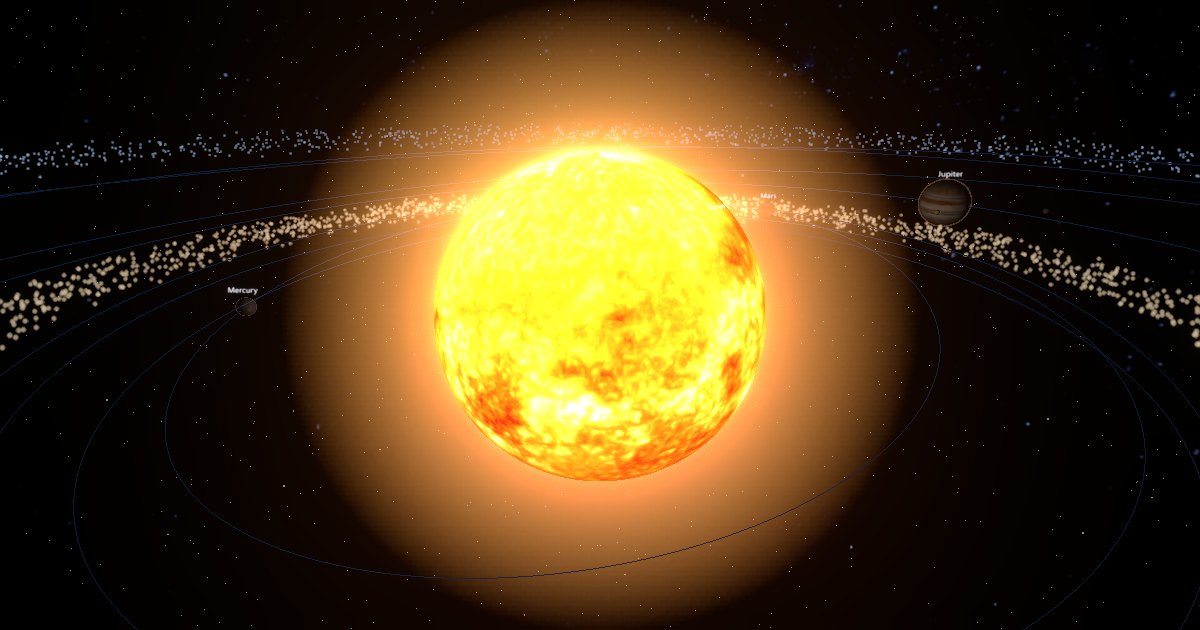
~2,000×the radius of the largest known stars
The Sun is a thoroughly average star — but stars range enormously. The largest known, hypergiants like Stephenson 2-18 and UY Scuti, are roughly 1,500–2,000 times the Sun’s radius. Drop one where the Sun sits and its surface would reach out past the orbit of Saturn, swallowing every rocky planet, the asteroid belt and Jupiter.
Stand next to the Sun in 3D
▶ Stand next to the Sun in 3D

The Sun is not big. Space is.

Our Sun holds 99.86% of the solar system’s mass and could fit 1.3 million Earths inside — yet among stars it is middling. Most stars in the galaxy are smaller, cooler red dwarfs. But the giants dwarf everything: Betelgeuse, the red shoulder of Orion, is around 700 times the Sun’s radius — placed here, its surface would engulf Mars and reach toward the asteroid belt. The true record-holders are two to three times larger still.

The largest stars are so vast that light — which crosses the Sun in about 4.6 seconds — would take hours to circle them once. Yet even the biggest star is a speck against the distance to the next one: the nearest star is over 250,000 times the width of our own Sun away.

Rough scale of the giants

Our Sun
1× (696,000 km radius)
A red dwarf (most common)
≈ 0.1–0.5× the Sun
Betelgeuse
≈ 700× — reaches the asteroid belt
UY Scuti
≈ 1,700× — reaches ~Saturn
Stephenson 2-18
≈ 2,150× — past Saturn
Nearest star (Proxima)
4.24 light-years away

These sizes carry real uncertainty — a hypergiant’s edge is a diffuse, pulsing thing, and estimates are revised often. That honesty is the point: the largest stars sit right at the limit of what we can measure. In the Cosmic Zoom, the Sun shrinks to nothing within the first breath of the journey to the stars.

Keep going

Facts verified July 2026

Every figure on this page is a real, rounded value checked against primary sources. Found something out of date? See how we keep it accurate.