When is the next solar eclipse?
Data as of July 2026
6 Feb 2027next solar eclipse (annular)
The next solar eclipse is on 6 February 2027: an annular eclipse, where the Moon is too far away to cover the Sun completely and leaves a "ring of fire", seen from Chile, Argentina, the South Atlantic. The next total solar eclipse is on 2 August 2027, crossing Spain, N. Africa, Egypt, and lasts up to 6 minutes 23 seconds over Egypt: the longest totality on land until 2114. The most recent was the total eclipse of 12 August 2026 over Greenland, Iceland, N. Spain.
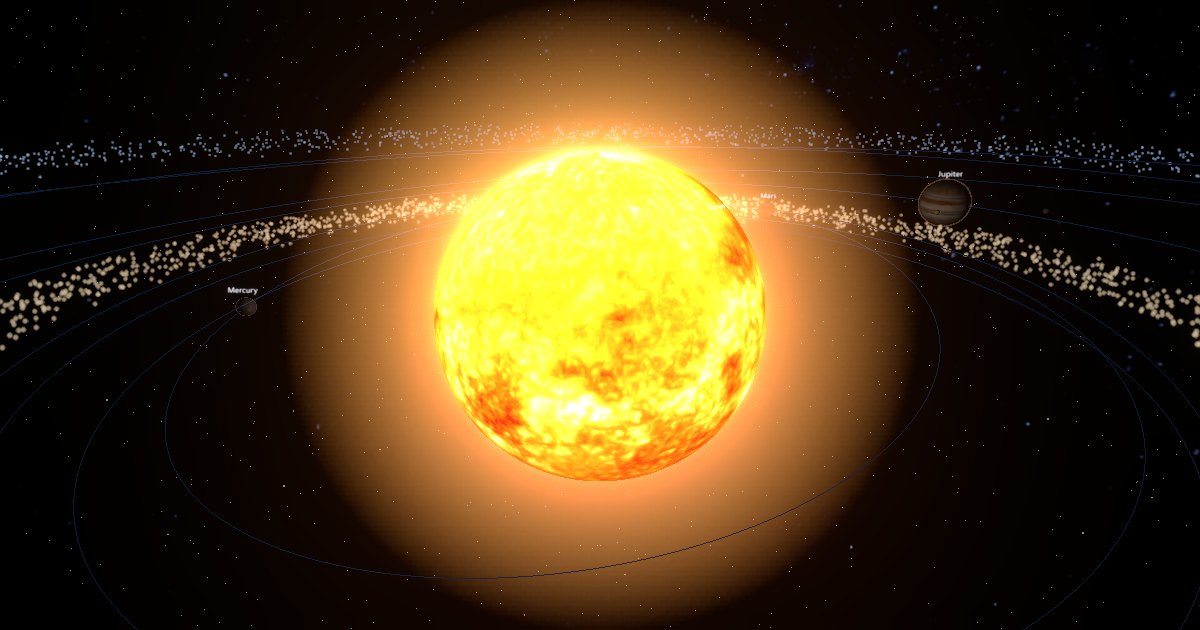
▶ See the Sun, Moon and Earth line up
Why a total eclipse is a coincidence
A solar eclipse happens when the Moon passes directly between the Sun and Earth. Totality is possible only because of a cosmic fluke: the Sun is about 400 times wider than the Moon, but also about 400 times farther away, so the two appear almost exactly the same size in our sky. Eclipses don’t happen every new moon because the Moon’s orbit is tilted about 5°: most months its shadow misses Earth entirely.
The Moon is drifting away from Earth at about 3.8 cm a year. In roughly 600 million years it will be too far to ever cover the Sun completely. The last total solar eclipse will happen, and there will never be another.
The upcoming eclipses
6 Feb 2027 (annular)
Chile · Argentina · the South Atlantic
2 Aug 2027 (total)
Spain · N. Africa · Egypt · longest
26 Jan 2028 (annular)
Ecuador · Peru · Brazil
22 Jul 2028 (total)
Australia · New Zealand
1 Jun 2030 (annular)
N. Africa · Europe · Russia
Moon and Sun size
both ≈ 0.5° across
Open the interactive view on eclipse day to see the Sun, Moon and Earth fall into line: the geometry that briefly turns day to night along one thin path on the planet.
Keep going
✓ Facts verified July 2026
Every figure on this page is a real, rounded value checked against primary sources. Found something out of date? See how we keep it accurate.