Voyager 1
Data as of July 2026
25,700,000,000km from the Sun: live, +17 every second
Voyager 1 is the farthest human-made object from Earth: 171 AU from the Sun and receding by 17 km every second. Its radio signal, transmitted with 23 watts, about a fridge lightbulb, takes 23.7 hours to reach us.
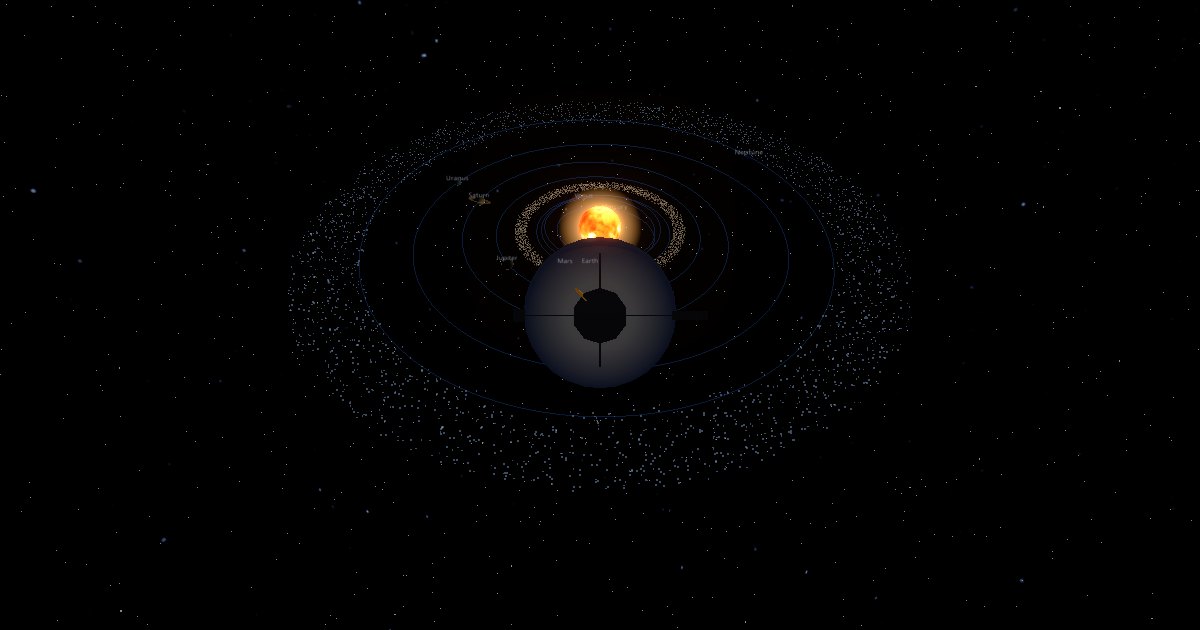
▶ Find Voyager 1 in 3D
The farthest thing we have ever touched
Launched on 5 September 1977, Voyager 1 flew past Jupiter and Saturn, then used their gravity to sling itself onto an escape trajectory from the Sun. In August 2012 it crossed the heliopause, the boundary where the Sun's wind gives way to the interstellar medium, becoming the first human-made object in interstellar space. It carries the Golden Record: sounds and images of Earth, chosen for anyone who might one day find it.
After nearly fifty years of continuous flight at 61,000 km/h, Voyager 1 has covered about 0.2% of the distance to the edge of the Sun's gravitational reach, and in 40,000 years it will pass within 1.6 light-years of another star, still travelling.
Voyager 1 by the numbers
Launched
5 September 1977
Speed
17 km/s (61,200 km/h)
Entered interstellar space
August 2012
Transmitter power
23 watts
Power source
plutonium RTG, fading
Expected to fall silent
around 2030
Cargo
the Golden Record
Next star encounter
~40,000 years
In the interactive view, Voyager 1 is a labelled spark far beyond the planets. Switch to 1:1 scale and appreciate the horror: that spark is our species' farthest reach, and it is barely out of the driveway.
Keep going
✓ Facts verified July 2026
Every figure on this page is a real, rounded value checked against primary sources. Found something out of date? See how we keep it accurate.