What is the biggest planet?
Data as of July 2026
139,820 kmJupiter: the biggest planet
The biggest planet is Jupiter: 139,820 km across, 11.0× wider than Earth. About 1,300 Earths would fit inside it, and it holds 2.5 times the mass of all the other planets put together.
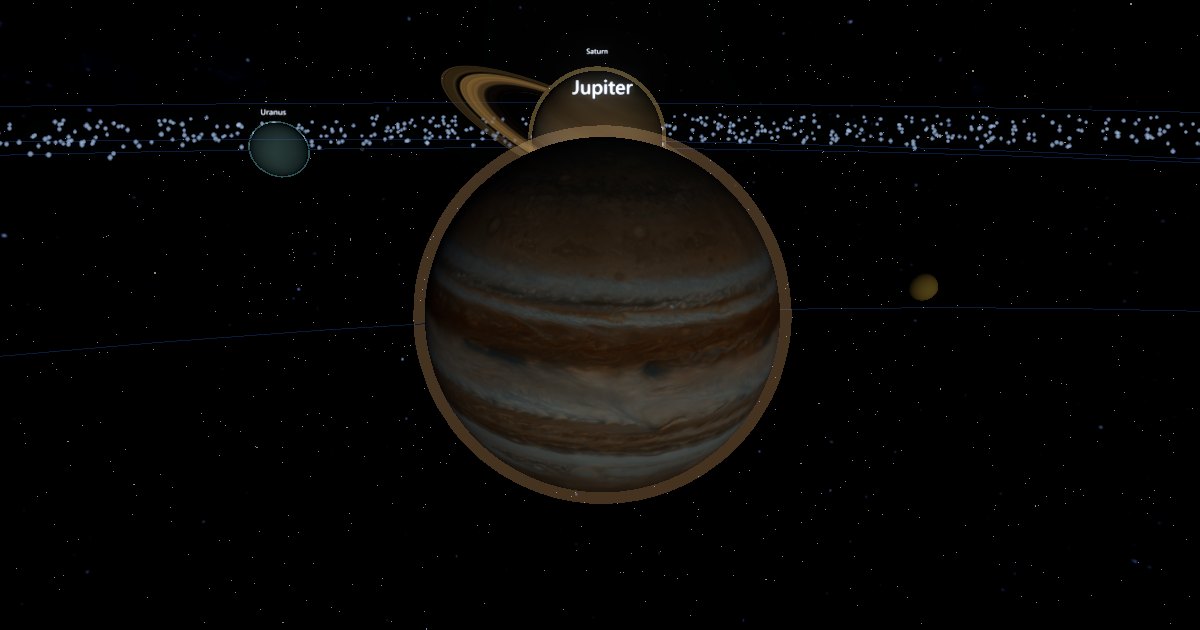
▶ Visit Jupiter in 3D
How big is big?
Jupiter is the second-largest object in the solar system after the Sun. Saturn comes closest among the planets at 116,460 km across, but Jupiter has more than three times its mass. And yet Jupiter is small for a star: the Sun is about ten times wider, and the smallest true stars are still dozens of times more massive than Jupiter.
Jupiter is about as wide as a gas planet can get. Add more mass and it would not grow much bigger: its own gravity would squeeze it tighter instead.
The planets by size
| Planet | Diameter | vs Earth |
|---|---|---|
| Jupiter | 139,820 km | 11.0× wider |
| Saturn | 116,460 km | 9.1× wider |
| Uranus | 50,724 km | 4.0× wider |
| Neptune | 49,244 km | 3.9× wider |
| Earth | 12,742 km | 1× |
| Venus | 12,104 km | 95% of its width |
| Mars | 6,779 km | 53% of its width |
| Mercury | 4,879 km | 38% of its width |
Ratios like this are hard to picture. In the interactive view, switch to True scale and set Earth beside it.
Keep going
✓ Facts verified July 2026
Every figure on this page is a real, rounded value checked against primary sources. Found something out of date? See how we keep it accurate.