What is the smallest planet?
Data as of July 2026
4,879 kmMercury: the smallest planet
The smallest planet is Mercury: 4,879 km across, about 38% of Earth's width and about 40% wider than our Moon. Two moons are wider than it: Jupiter's Ganymede (5,268 km) and Saturn's Titan (5,150 km).
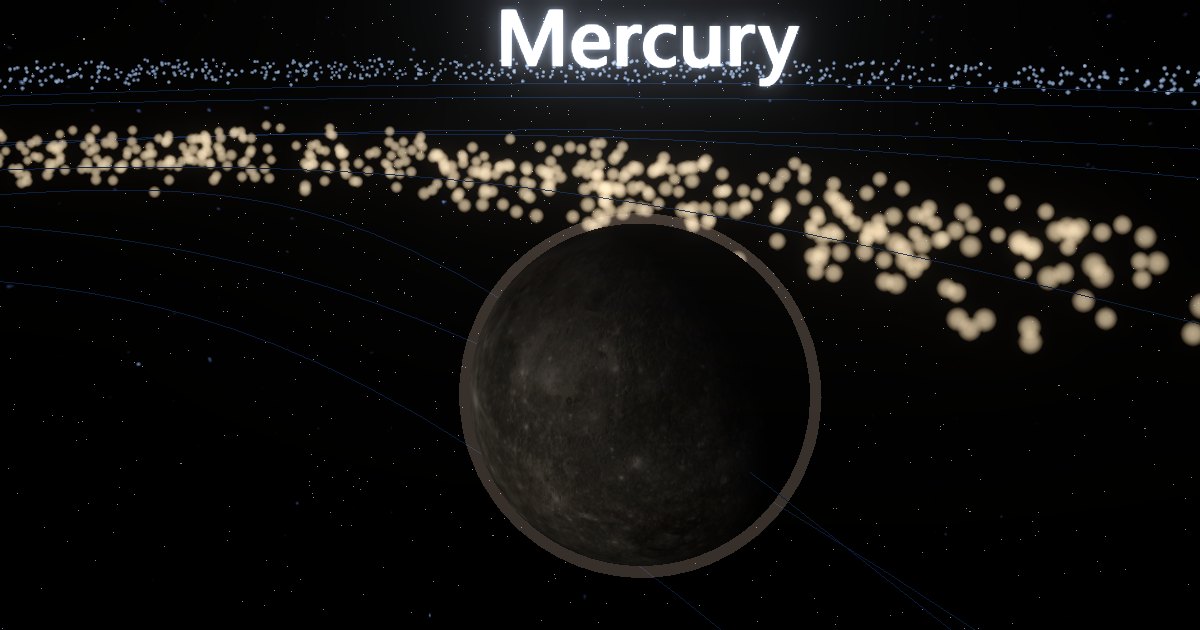
▶ Visit Mercury in 3D
Small, but heavy
Wider moons do not make Mercury the lightweight. It has a huge iron core, so it is about twice as massive as Ganymede and is the second-densest planet after Earth. Until 2006 the answer to this question was Pluto, at 2,377 km; it is now classed as a dwarf planet, which leaves Mercury the smallest of the eight.
Mercury is shrinking. As its iron core cools it contracts, and the planet has narrowed by several kilometres, wrinkling its surface into cliffs hundreds of kilometres long.
The planets by size
| Planet | Diameter | vs Earth |
|---|---|---|
| Jupiter | 139,820 km | 11.0× wider |
| Saturn | 116,460 km | 9.1× wider |
| Uranus | 50,724 km | 4.0× wider |
| Neptune | 49,244 km | 3.9× wider |
| Earth | 12,742 km | 1× |
| Venus | 12,104 km | 95% of its width |
| Mars | 6,779 km | 53% of its width |
| Mercury | 4,879 km | 38% of its width |
See how small it really is in the interactive view, then switch to 1:1 scale and watch it vanish against its orbit.
Keep going
✓ Facts verified July 2026
Every figure on this page is a real, rounded value checked against primary sources. Found something out of date? See how we keep it accurate.