What is the hottest planet?
Data as of July 2026
464 °CVenus: the hottest planet
The hottest planet is Venus, with a surface averaging about 464 °C: hot enough to melt lead. Counter-intuitively it is not Mercury, even though Mercury orbits closer to the Sun: Venus is wrapped in a dense carbon-dioxide atmosphere that traps heat in a runaway greenhouse effect, and Mercury has almost no atmosphere at all.
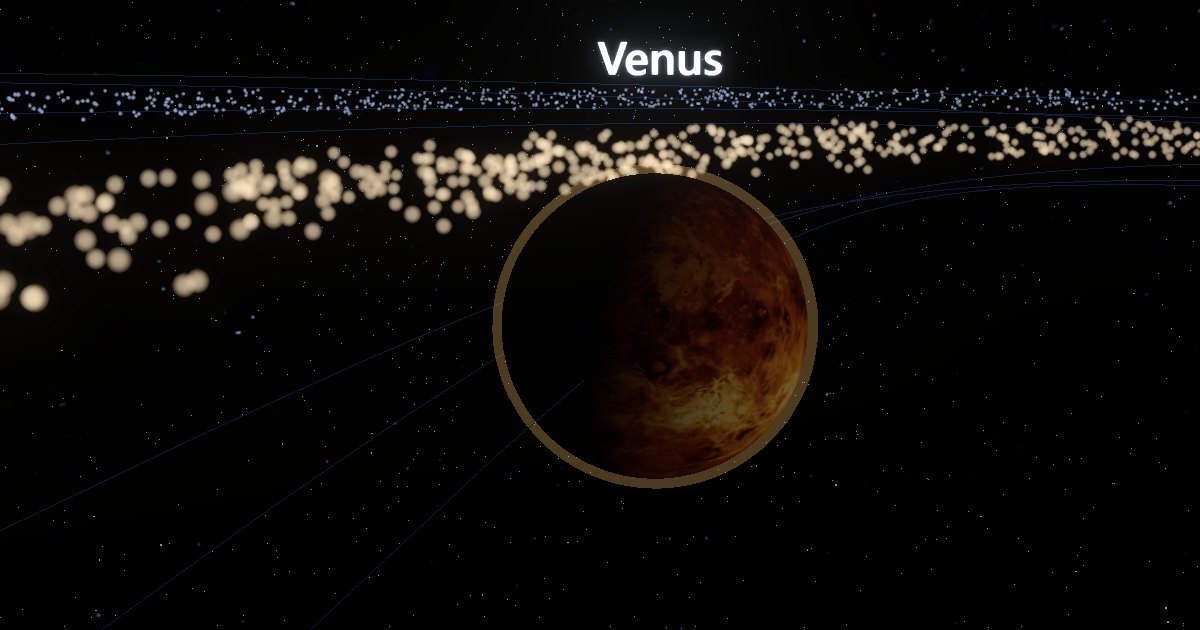
▶ Visit Venus in 3D
Why closer to the Sun doesn't mean hotter
Mercury's day side does reach around 430 °C, but with no atmosphere to hold that heat, its night side plunges to −180 °C. Venus's thick CO₂ blanket, by contrast, spreads and traps the heat so completely that its surface stays around 464 °C everywhere, day and night, pole to equator. That greenhouse trap, not proximity to the Sun, is what makes Venus the hottest place among the planets.
Venus is the hottest planet and one of the brightest, most Earth-like worlds in size: a preview of how badly a greenhouse effect can run away, sitting right next door.
The planets by temperature
Venus
464 °C average
Mercury
167 °C average
Earth
15 °C average
Mars
−63 °C average
Jupiter
−110 °C at cloud tops
Saturn
−140 °C at cloud tops
Uranus
−195 °C
Neptune
−200 °C
Stand over Venus yourself in the interactive view: the pale, featureless cloud deck hides everything that makes it the solar system's furnace.
Keep going
✓ Facts verified July 2026
Every figure on this page is a real, rounded value checked against primary sources. Found something out of date? See how we keep it accurate.