What is the heliopause?
Data as of July 2026
≈ 120 AUfrom the Sun: about 18 billion km
The heliopause is the boundary where the solar wind, the Sun’s constant outflow of charged particles, is finally halted by the thin gas of interstellar space. It lies about 120 AU from the Sun (roughly 18 billion km), and only two spacecraft, Voyager 1 and Voyager 2, have ever crossed it.
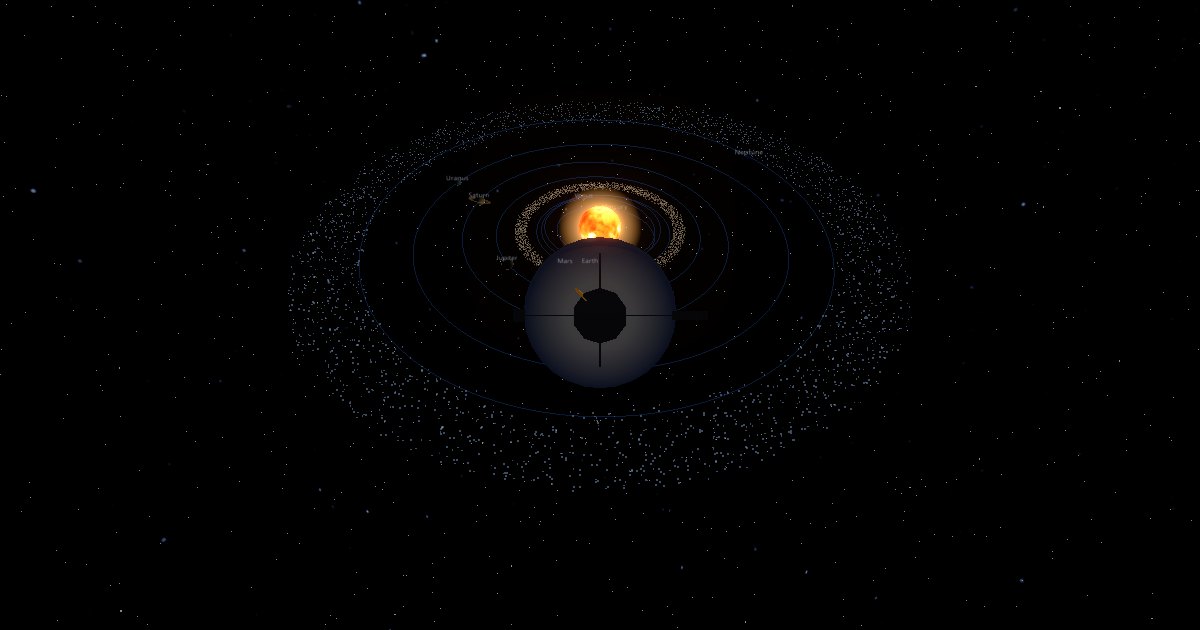
▶ Follow Voyager past the heliopause
The edge of the Sun’s bubble, but not of the solar system
The Sun blows a vast bubble of charged particles and magnetic field called the heliosphere. The heliopause is that bubble’s outer skin: the place where the solar wind’s outward pressure finally balances the pressure of the interstellar medium, and the Sun’s wind gives way to the gas between the stars. Voyager 1 crossed it in August 2012 at about 121 AU; Voyager 2 followed in November 2018 at about 119 AU: our only two direct measurements ever.
Crossing the heliopause is not leaving the solar system. The Sun’s gravity holds comets in the Oort Cloud out to roughly 100,000 AU: nearly a thousand times farther. Voyager 1 will not reach that true gravitational edge for around 300 centuries.
By the numbers
Distance from the Sun
≈ 120 AU (18 billion km)
Voyager 1 crossing
August 2012, ~121 AU
Voyager 2 crossing
November 2018, ~119 AU
What stops there
the solar wind
What lies far beyond
the Oort Cloud, ~100,000 AU
Spacecraft to cross it
just two, ever
In the interactive view, Voyager 1 sits far beyond the planets: a labelled spark at its real, live-updating distance, still transmitting from the far side of the heliopause.
Keep going
✓ Facts verified July 2026
Every figure on this page is a real, rounded value checked against primary sources. Found something out of date? See how we keep it accurate.